 Scallop
 Pool Types and Borrowing Rules
Last updated -Scallop is a money market on Sui with separate lending and collateral pools. For collateral-backed loans, the borrowed asset’s class determines the base upfront borrowing fee, and isolated debt cannot share an Obligation with another debt type.
- Lending supplies earn interest, and suppliers receive sCoins representing their supplied assets and accrued interest.
- Collateral deposits support borrowing capacity within an Obligation and do not earn interest in the collateral pool.
Asset Classes and Borrowing Fees
The borrowing fee is deducted from the loan amount when a collateral-backed loan is taken, reducing the amount that the borrower receives. In Referral Program v2, a borrowing wallet bound to a referrer’s veSCA key can receive a discount based on that key’s current veSCA tier.
| Asset Class | Upfront Borrowing Fee | Class Characteristics and Constraints |
|---|---|---|
| Main Assets | 0.3% of the loan amount before any referral discount | Widely supported assets across Sui protocols, generally with higher liquidity and lower price volatility. |
| Emerging Assets | 1% of the loan amount before any referral discount | Can be used as collateral, with lower collateral weights and tighter risk parameters than main assets. |
| Isolated Assets | 1% of the loan amount before any referral discount | An Obligation with isolated debt can hold only that debt asset type, excluding all other debt types, including other isolated assets. |
| Fee and Collateral | The borrowed asset determines the fee category; the deposited collateral has its own collateral weight. An asset cannot be both collateral and debt in the same Obligation. | |
Isolated Debt and Independent Obligations
An
Obligation
records a borrowing position’s collateral and debt. Multiple collateral assets may support its single isolated debt asset. Adding another collateral token does not remove the restriction on holding other debt types.
Existing isolated debt must be repaid in full before the same Obligation can borrow a different asset. A separate Obligation allows another borrowing position to coexist under the same address, but it needs its own collateral. Collateral deposited in one Obligation cannot support borrowing in another. Borrowing against a position requires its matching
ObligationKey
as proof of ownership.
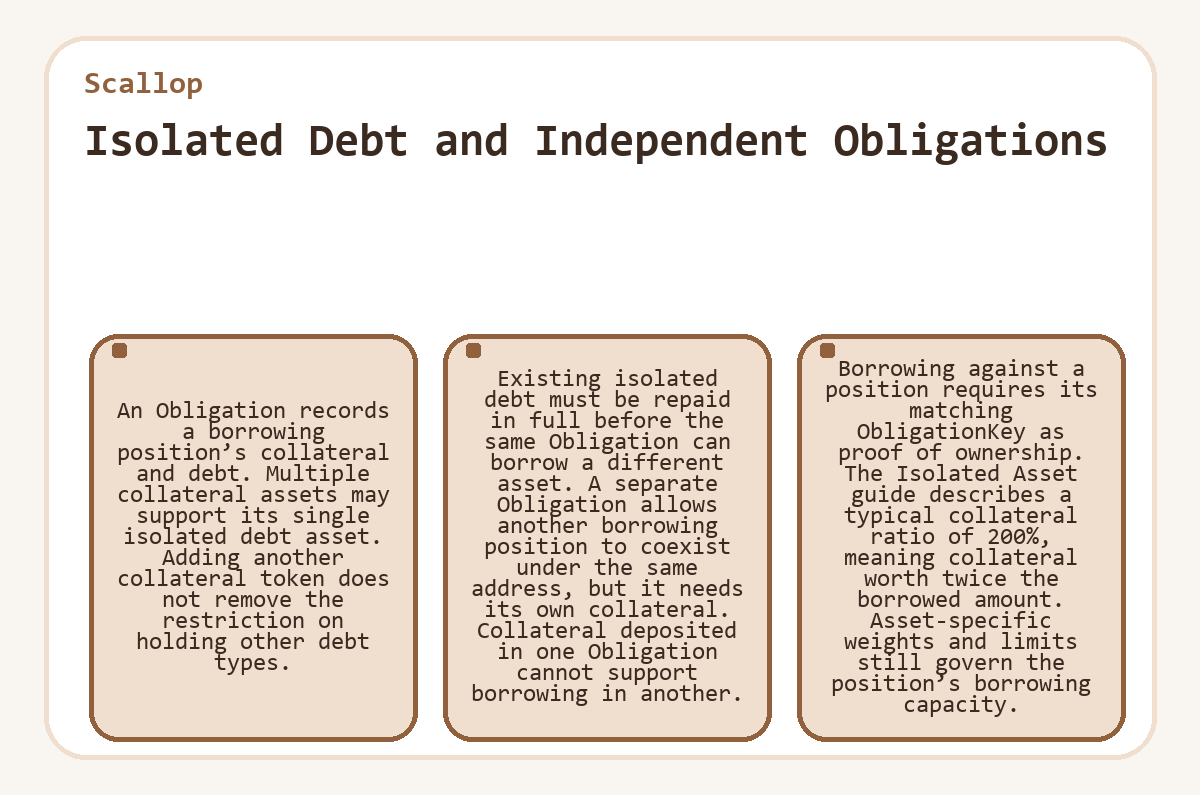
The Isolated Asset guide describes a typical collateral ratio of 200%, meaning collateral worth twice the borrowed amount. Asset-specific weights and limits still govern the position’s borrowing capacity.
Weights, Deposit Caps, and Pool Liquidity
- Collateral Weight
- The share of a deposited collateral asset’s market value that contributes to borrowing capacity. Changes to this weight affect positions already using that collateral.
- Borrow Weight
- A multiplier applied to the borrowed asset’s value when assessing weighted debt. A higher borrow weight permits less borrowing for the same collateral, with other inputs unchanged.
- Collateral Capacity
- The total deposit cap for each collateral asset. Once that cap is reached, further collateral deposits in that asset are blocked.
- Available Pool Reserves
- The lending pool must have enough available reserves to fund a requested loan.
- Outflow Allowance
- A constraint on combined borrowing and withdrawal outflows, configurable for each asset and pool. A remaining outflow allowance is separate from the borrowing capacity of an individual Obligation.
Collateral weight also differs from the liquidation factor. The former contributes to borrowing capacity; the latter determines how much collateral value counts when assessing liquidation eligibility.
Interest and Other Loan Costs
Ongoing borrowing interest follows the pool’s utilization-dependent rate. Two assets with the same upfront fee can therefore have different interest costs. Scallop’s documented trilinear model uses three utilization ranges, with borrowing rates increasing as utilization rises. Sui gas and applicable oracle-update charges are separate transaction costs.
Flash loans use a separate fee structure: the documented protocol fee is 0.1% of the flash-loan amount, with Sui gas additional. The borrowed assets must be returned within the same blockchain transaction.