 Scallop
 liquidation
Last updated -A borrowing position in Scallop’s Sui money market becomes eligible for liquidation at a Risk Level of 100% or more. A liquidator repays debt and receives collateral. Each call can repay up to 20% of the position’s total debt value across all debt types, with full repayment allowed when total debt is below $10.
Risk Level and Obligation Scope
An
Obligation
records the collateral and debt of a Scallop borrowing position. Separate Obligations remain independent, including those owned by the same address: collateral recorded in one does not support debt in another.
- Weighted Debt Value
-
The combined USD value of borrowed assets, adjusted by each asset’s
borrow_weight. A higher borrow weight makes that debt count more heavily when assessing the position. - Collateral Value for Liquidation
-
The combined USD value of deposited collateral, adjusted by each asset’s
liquidation_factor.
Scallop expresses the ratio of weighted debt to collateral value for liquidation as the Risk Level. Equality puts the position at the 100% liquidation threshold. Collateral weight, which contributes to the capacity for new borrowing, is a separate parameter from the liquidation factor.
Falling collateral prices, rising borrowed-token prices, and accruing interest can increase the Risk Level without a new borrowing transaction. Repaying debt or adding eligible collateral to the affected Obligation can lower it, with collateral deposits limited by the asset’s remaining deposit capacity. Changes to applicable risk parameters can also alter the assessment.
Repayment Bounds and Repeated Calls
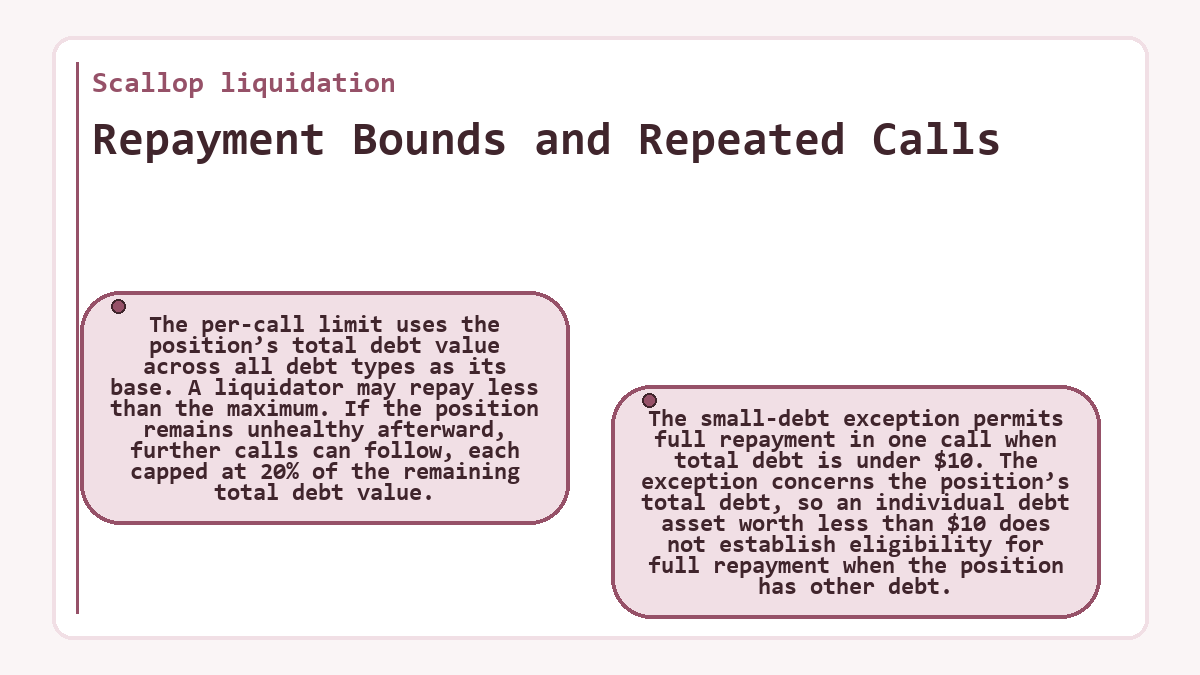
The per-call limit uses the position’s total debt value across all debt types as its base. A liquidator may repay less than the maximum. If the position remains unhealthy afterward, further calls can follow, each capped at 20% of the remaining total debt value.
The small-debt exception permits full repayment in one call when total debt is under $10. The exception concerns the position’s total debt, so an individual debt asset worth less than $10 does not establish eligibility for full repayment when the position has other debt.
Weighted Debt and the Repayment Cap
A hypothetical Scallop Obligation has one debt type with a total debt value of $2,346, a borrow weight of 1.25, and collateral value for liquidation of $2,850 after liquidation factors are applied. Hold prices fixed, assume no additional interest during the calculation, and assume a successful call repays the full permitted amount.
Weighted debt is $2,346 × 1.25 = $2,932.50. Its Risk Level is $2,932.50 ÷ $2,850 × 100% ≈ 102.89%, making the position eligible for liquidation even though its unweighted debt is below its collateral value for liquidation.
The maximum repayment is $2,346 × 20% = $469.20. Crediting that full repayment leaves $2,346 - $469.20 = $1,876.80 in debt.
Changing the hypothetical borrow weight would change the eligibility calculation. With the same $2,346 total debt, the 20% repayment cap would remain $469.20. Post-call health also depends on the collateral that was seized.
Collateral Seizure and Debt Credit
A successful liquidation reduces the borrower’s debt by the full amount that the liquidator repays. The collateral removed has a greater value than that debt reduction because the borrower incurs a liquidation penalty.
Scallop’s Liquidation documentation describes collateral-specific penalties with a maximum of 20% and liquidator discounts with a maximum of 15%. It assigns the difference between the penalty and discount to the protocol as collateral-side revenue. The repayment cap measures a share of outstanding debt; the penalty and discount govern the collateral exchanged for that repayment.
Liquidator Access and Execution Evidence
Liquidation is permissionless, with no whitelist required. Other participants can liquidate an eligible position, while owner-authorized borrowing and collateral withdrawal require the matching
ObligationKey
.
The Liquidation Function integration guide specifies an oracle-price update before the liquidation call within the Sui
programmable transaction block. For the documented call, the liquidator supplies a coin object containing the debt asset being repaid and selects a collateral type held in the Obligation. The call returns any unused repayment coins and the seized collateral. The guide also documents
LiquidateEventV2
as the liquidation event. A submitted transaction alone does not establish that debt has been repaid; execution must succeed.
For Sui mainnet integrations, the documented SDK’s
ScallopQuery
exposes
queryObligation(obligationId)
to read the position. After successful execution, reconcile the debt reduction and collateral removal in that Obligation, then assess its updated weighted values. Further liquidation remains possible at a Risk Level of 100% or more; a position below that threshold is no longer eligible.