 Scallop
 veSCA Use Cases
Last updated -Locking SCA in Scallop’s money market on Sui creates veSCA, a balance that declines as the unlock date approaches. Its practical uses include boosting eligible pool incentives and setting referral tiers for upfront borrowing-fee discounts and fee shares.
- Incentive boosts depend on the pool offering applicable incentives, the holder’s veSCA share, and the position size.
- Referral Program v2 uses the current balance of the bound veSCA key. Self-referral combines the borrower’s discount with the referrer’s share.
Lock Timing and Balance Decay
Scallop calculates veSCA from the locked SCA amount and the remaining lock duration:
veSCA = locked SCA * (remaining lock period / 4 years)
, with both durations expressed in matching units. For an unchanged SCA amount and unlock date, the veSCA balance falls toward zero. The locked SCA can be redeemed in full after expiry.
Unlock dates fall at 00:00 UTC. Locks use 24-hour rounds, require at least one complete round, and have a maximum of 1,460 rounds, described as four years. A selected midnight must leave at least a full 24-hour round between locking and expiry.
Adding SCA to an unexpired lock increases its veSCA balance. Extending the lock increases the remaining-time component, but the chosen lock period cannot be shortened. A longer lock therefore increases weighting while postponing access to the SCA principal. ScallopBuilder exposes separate operations for extending an unexpired lock, renewing expired veSCA, and redeeming unlocked SCA.
Incentive Boosts
An incentive-bearing pool and the applicable veSCA holding are prerequisites for a boost. Scallop lists Borrow Reward Boost among veSCA benefits, and its pool-incentive explanation ties the multiplier to the holder’s veSCA share and position size. For the liquidity-based boost described there, veSCA must be held when funds are deposited; increasing supplied liquidity requires more veSCA to maintain the same boosted APR.
Scallop expresses the reward relationship as
EarningAPR = PoolIncentiveAPR * EarningBoost
. The multiplier applies to the pool-incentive component. Borrowing interest and upfront borrowing fees have separate calculations.
The displayed Boost Value can require a refresh. Scallop’s staking page has a Refresh Boost action; borrowing, supplying, repaying, staking SCA, and extending the lock period also refresh the value. A refreshed multiplier describes reward weighting, without establishing that a reward has been claimed.
Referral Discounts and Fee Shares
Referral Program v2 binds the borrowing wallet address to a referrer’s veSCA key, covering every Obligation account in that wallet. Each veSCA key has its own referral link. The tier follows the current balance of that particular key, so decay can lower its discount and fee share.
A borrower can receive another holder’s referral discount without creating a personal SCA lock. Self-binding instead uses the borrower’s own veSCA key and combines its discount with its referral share. The other holder’s discount and the combined rebate on the borrower’s own key are different ways to reduce the borrowing-fee cost, with rates determined by the respective keys.
The base upfront borrowing fee is 0.3% of the loan amount for main assets and 1% for emerging and isolated assets. The referral discount reduces the fee deducted from the loan at borrowing. The referrer’s share is also calculated from the base fee, before that discount. The referral discount and share percentages apply to the base borrowing fee; loan interest, network charges, and applicable oracle fees remain separate.
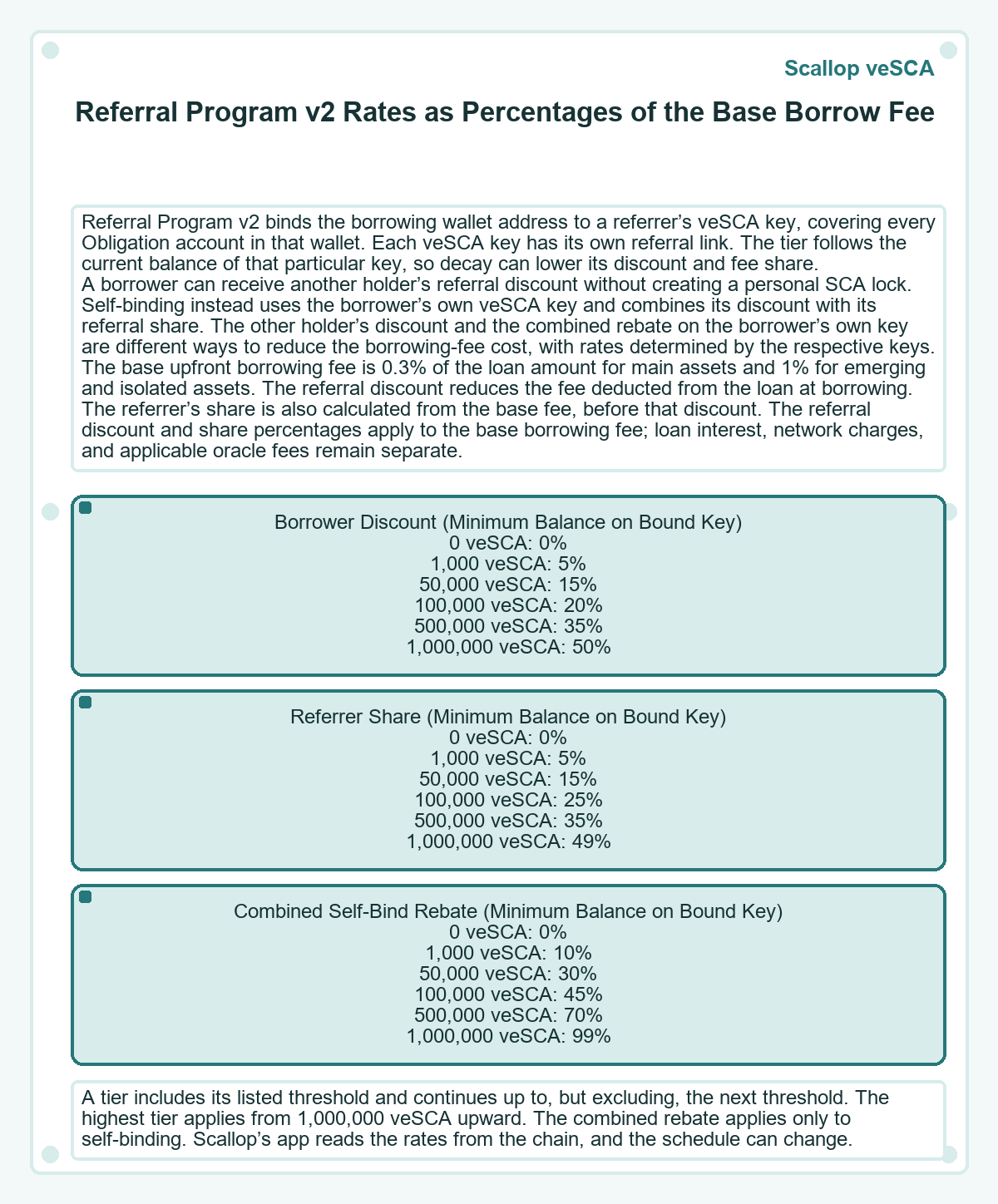
| Minimum Balance on Bound Key | Borrower Discount | Referrer Share | Combined Self-Bind Rebate |
|---|---|---|---|
| 0 veSCA | 0% | 0% | 0% |
| 1,000 veSCA | 5% | 5% | 10% |
| 50,000 veSCA | 15% | 15% | 30% |
| 100,000 veSCA | 20% | 25% | 45% |
| 500,000 veSCA | 35% | 35% | 70% |
| 1,000,000 veSCA | 50% | 49% | 99% |
A tier includes its listed threshold and continues up to, but excluding, the next threshold. The highest tier applies from 1,000,000 veSCA upward. The combined rebate applies only to self-binding. Scallop’s app reads the rates from the chain, and the schedule can change.
Referral Binding and Reward Claims
Link creation uses a wallet message signature. If the wallet holds no veSCA key, the app first creates an empty key through a transaction. Accepting a referral is a separate transaction; Scallop’s My Referrer panel identifies the accepted referrer and discount. An empty key falls in the zero-discount, zero-share tier.
A wallet has one referrer at a time in v2. A completed switch unbinds the old referrer and binds the new one in a single transaction. Unbinding ends the discount while preserving fees already saved, and another link can be accepted later, including the wallet’s own link.
The Referral Overview panel shows pending rewards. A completed claim aggregates fees across the holder’s veSCA keys, swaps them to SCA, supplies that SCA, and delivers sSCA. The resulting reward represents a lending position that earns lending yield. A pending fee amount is distinct from the sSCA received after a completed claim.
Self-Referral From a $23 Base Fee
Hypothetical inputs: a base upfront borrowing fee valued at $23, a balance of 100,003 veSCA on the bound key when borrowing, and an already accepted self-binding. Assume the stated v2 schedule applies. The key qualifies for the 100,000 veSCA tier, with a 20% borrower discount and a 25% referrer share.
-
Fee charged after the discount:
$23 * (1 - 0.20) = $18.40. -
Referral share accrued to the borrower’s own key:
$23 * 0.25 = $5.75. -
Borrowing-fee cost after accounting for that accrued share:
$18.40 - $5.75 = $12.65.
The $5.75 represents accrued referral fees; reward settlement follows the sSCA claim mechanism. The $12.65 result compares fee components before loan interest, network charges, applicable oracle fees, and any change in value during reward conversion. Those percentages apply only while the key remains in that tier and the v2 schedule is unchanged. A different base fee scales the charged fee, accrued share, and resulting net cost.
Loyalty and Governance
The loyalty design describes token buybacks at revenue milestones for distribution to veSCA holders. Scallop’s veSCA documentation places the loyalty description under a Q2 2024 heading and governance under a Q3 2024 heading; its benefit list labels voting as coming soon. These dated descriptions do not establish present voting availability or the completion of any particular loyalty distribution.